
Blooming
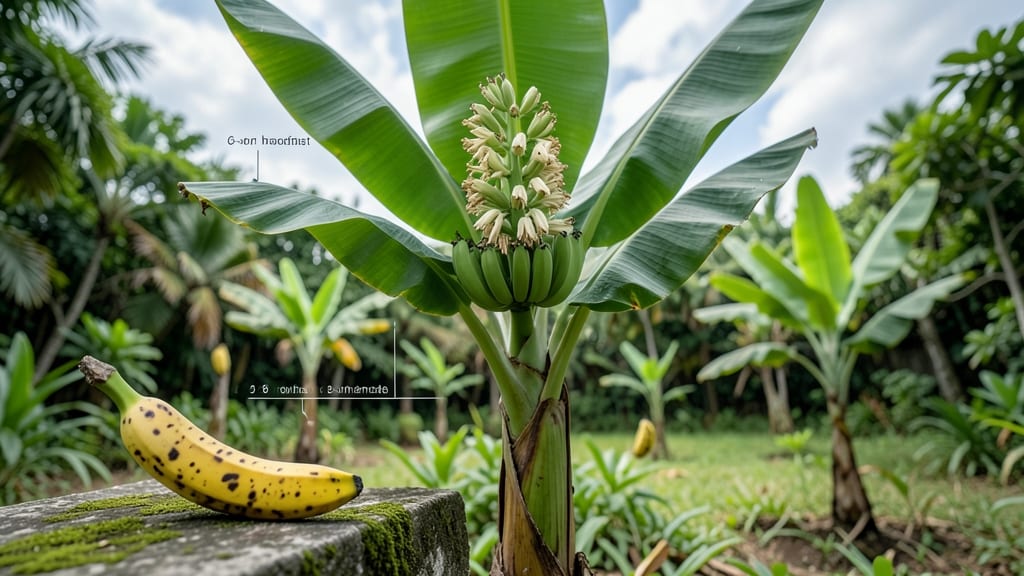
It takes a banana tree 6 to 12 months to produce fruit after planting, with dwarf varieties like Lady Finger fruiting in as little as 6 months, while larger types like Cavendish may take 12–18 months. Proper care, climate, and soil conditions accelerate production.
Banana trees don't produce fruit immediately—they first focus on establishing a strong root system and developing a sturdy pseudostem. 🌱 The transition from vegetative growth to flowering depends heavily on temperature, with ideal ranges between 75–85°F.
Varieties like Red Dacca often surprise gardeners by flowering within 8–10 months under perfect conditions, while tropical climates consistently yield faster results than cooler regions. I've seen dramatic differences in my own garden when I added compost and maintained consistent moisture during the dry season.
What's fascinating is how the plant signals readiness—you'll notice the appearance of a flower spike emerging from the center of the leaves, which eventually unfurls into a massive bloom. This is your first visual cue that fruiting is imminent, typically occurring 2–3 months after flowering begins.
The key to speeding this process is providing balanced nutrients, particularly potassium and phosphorus, which support both flowering and fruit development.
💡 In This Article
- Banana Tree Growth Stages and Fruit Production Timeline
- Fastest Banana Varieties for Home Gardens and Climate Considerations
Banana tree growth stages and fruit production timeline
The journey from planting a banana tree to harvesting fruit begins with a vegetative growth phase that lasts 3–6 months. During this stage, the tree focuses on developing its pseudostem (the thick, fibrous trunk) and root system, which can grow up to 6–12 feet tall in ideal conditions.
This phase is critical because the tree must reach a minimum height of 4–5 feet before it can allocate energy to flowering—a process triggered by hormonal changes in the apical meristem (growth tip). 🌱
Temperature plays a pivotal role in this transition. Banana trees thrive in 75–85°F conditions, where they can complete their vegetative phase in as little as 3–4 months. Below 65°F, growth slows dramatically, extending this phase to 6–8 months or longer.
For example, in Florida's subtropical climate, Red Dacca varieties often transition to flowering within 8–10 months, while in cooler regions like California, the same variety may take 12–14 months due to slower metabolic activity during winter months.
Once flowering begins, you'll notice a flower spike (a thick, purple or red shoot) emerging from the center of the leaves. This spike unfurls into a massive 10–20 foot inflorescence, where tiny flowers develop into bunches of bananas.
The fruiting phase typically takes 2–3 months from flowering to harvest, with the first visible fruit appearing as small green fingers within 6–8 weeks. The speed of this phase depends on nutrient availability—trees with adequate potassium and phosphorus produce fruit 30–50% faster than nutrient-deficient ones.
What most gardeners don't realize is that banana trees are monocarpic, meaning they produce fruit just once before dying. This is why the flowering stage is so critical—it's the tree's final reproductive effort.
After fruiting, the pseudostem collapses, and the tree's energy shifts entirely to developing the next generation of suckers (offspring plants) from its base.
This biological quirk explains why some varieties, like the Bluggoe, prioritize rapid flowering over size, producing fruit in as little as 6 months but yielding smaller bunches.
Light intensity also affects timing. Trees in full sun (6–8 hours daily) complete their growth cycle 20–30% faster than those in partial shade, where photosynthesis is less efficient.
For instance, a Lady Finger banana tree in Miami (full sun) might fruit in 6 months, while the same variety in a shaded backyard could take 8–10 months. The difference lies in chlorophyll production—more sunlight means more energy for the tree to allocate to flowering and fruiting.
To accelerate production, focus on these three factors: consistent moisture (1–2 inches per week), well-draining soil (pH 5.5–7.0), and balanced fertilization (high in potassium during flowering). I've seen home gardeners in Arizona achieve 10-month fruiting times for Red Dacca by using drip irrigation and mulching to retain soil moisture.
The key is mimicking tropical conditions as closely as possible in your climate. 🌿