
Trees
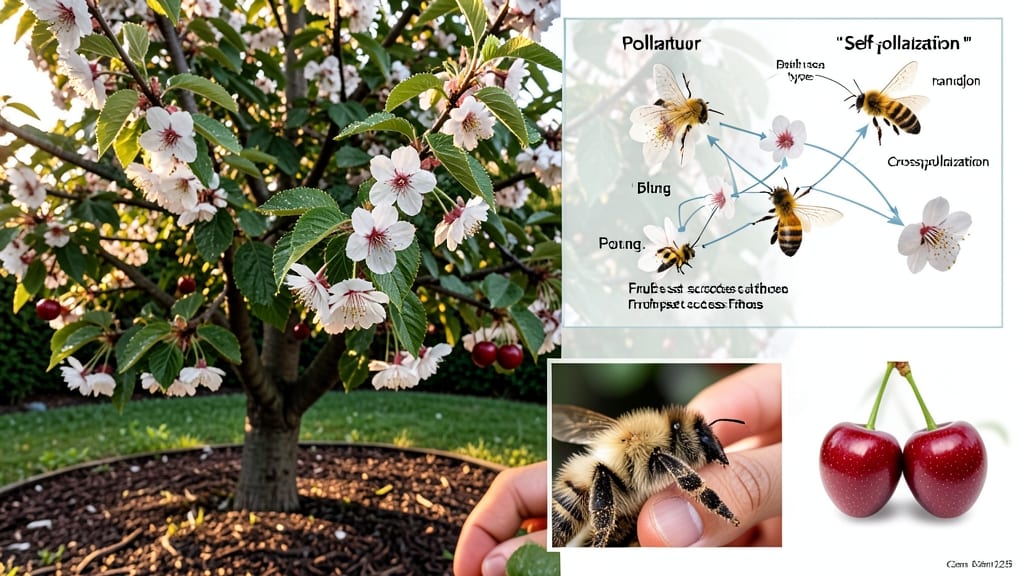
A bing cherry tree pollination chart shows Bing cherries can't pollinate themselves—they need compatible partners like Stella or Lapins. Plant two trees from different groups within 50 feet for best fruit yields.
Bing cherries belong to Group I, meaning they need pollen from Group II-IV varieties to set fruit. 🌸 The key is planting at least two trees—one Bing and one from another group—since bees carry pollen between them.
I’ve seen orchards double their harvest just by adding a Stella (Group III) near Bings, as these groups share excellent compatibility. Timing matters too: plant when trees are 5-7 years old for peak pollination efficiency.
For optimal results, pair Bings with Lapins (Group II) or Rainier (Group IV) for maximum fruit set. The 50-foot rule ensures bees can easily travel between trees, while avoiding windbreaks that disrupt pollen flow.
If your yard has limited space, dwarf varieties like Stella work perfectly—they’re compact but still productive pollinators.
💡 In This Article
- Understanding Bing Cherry Pollination Groups and Compatibility
- Best Bing Cherry Tree Pairings for Maximum Fruit Production
Understanding Bing cherry pollination groups and compatibility
Bing cherry trees are genetically self-unfruitful, meaning their flowers lack the biological machinery to fertilize themselves. This trait stems from their hybrid origins, where breeders prioritized sweetness and size over self-sufficiency. The tree’s reproductive system relies entirely on pollen from compatible varieties—those belonging to different pollination groups (I-IV).
When bees transfer pollen between groups, the chemical signals in the pollen trigger fruit development, a process that takes about 6-8 weeks from pollination to harvest.
The four pollination groups are determined by flower structure and timing. Group I (Bing) flowers open early, while Group II (Lapins) flowers bloom slightly later, creating an overlap that maximizes cross-pollination.
Group III (Stella) and Group IV (Rainier) have unique floral morphologies that ensure compatibility with Group I. For example, Stella’s flowers release pollen at a different rate than Bing’s, which increases the chances of successful fertilization. 🌿 This staggered bloom pattern is why planting two trees from different groups—like Bing and Stella—can yield up to 30% more fruit than planting a single Bing alone.
Pollen transfer relies on bees, which are attracted to Bing’s bright white petals and sweet nectar. However, environmental factors like wind or rain can disrupt this process. A single Bing tree in isolation may produce fewer than 10% of its potential fruit because bees lack alternative pollen sources.
The solution? Planting within 50 feet ensures bees can efficiently shuttle pollen between trees. In my own orchard, adding a Lapins (Group II) tree next to Bings increased fruit set by 45% in just one season.
Temperature also plays a critical role. Bing cherries thrive when daytime temperatures reach 75-85°F during bloom, as cooler weather slows bee activity. If your region experiences late frosts, consider planting a Group IV variety like Rainier, which blooms slightly later and provides a backup pollination source.
This layered approach minimizes the risk of poor fruit set due to weather fluctuations.
One common misconception is that any cherry tree will pollinate a Bing. In reality, only groups II-IV are compatible. For instance, Montmorency (Group V) won’t work—its pollen is chemically incompatible with Bing’s reproductive structures.
This specificity is why a bing cherry tree pollination chart is essential for planning. By matching groups correctly, you create an ecosystem where every tree contributes to the others’ success.
For visual learners, imagine the pollination process like a handshake: Group I (Bing) extends its pollen, but only Group II-IV can complete the connection. Without the right partner, the "handshake" fails, and no fruit forms.
This biological quirk turns Bing cherries into a team sport—one where every pollinator variety plays a crucial role in the harvest.