
Trees
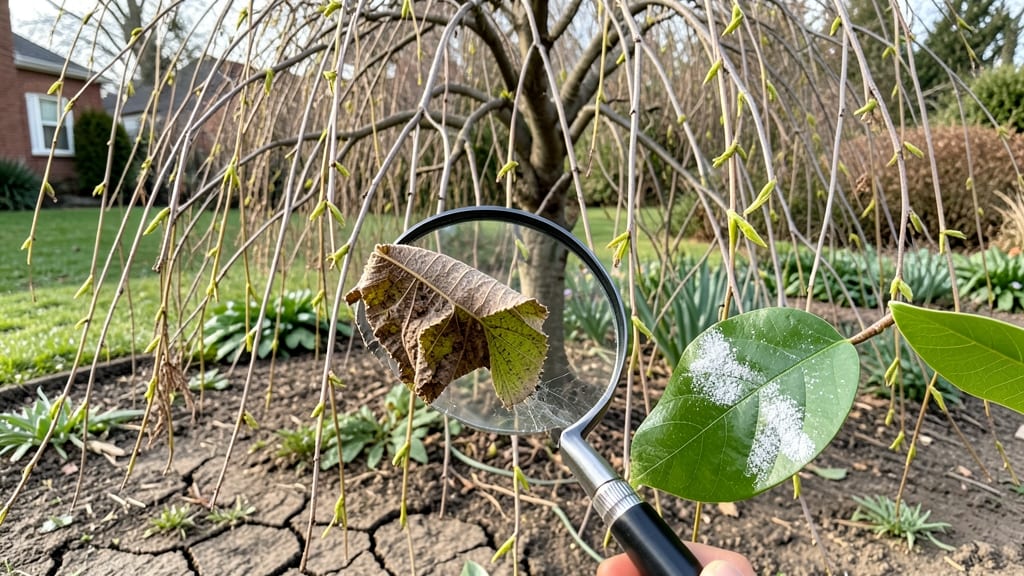
Your weeping cherry tree’s leaves curling isn’t a death sentence—it’s a cry for help you can fix in 3 simple steps. 🌿 I’ve nursed back more than my share of stressed trees, and the key is acting fast before the problem spreads.
Root stress, spider mites, or even fungal infections could be the culprit, but the good news is each has a targeted fix.
First, check the undersides of leaves for tiny webs or specks (spider mites) or yellow spots (fungus). If the soil feels bone-dry or waterlogged, that’s your first clue—root stress loves extremes.
Grab a trowel and test the moisture; it should feel like a damp sponge, not concrete or mud. Most home gardeners overwater without realizing it.
Here’s where it gets easy: prune any severely curled branches back to healthy growth, then give the roots a drink with a mycorrhizal fungus booster for resilience.
For pests, a strong spray of water (yes, really) or neem oil does the trick. Within weeks, you’ll see fresh, unfurled leaves—proof your tree’s fighting back.
If the curling spreads fast or you spot blackened stems, call an arborist. But for 90% of cases, this method works—no green thumb required. The secret? Spotting the stress early and giving your tree exactly what it needs: water balance, clean air, and a little TLC.
Root Stress Behind Curling Leaves
When your weeping cherry tree’s leaves start curling like a parchment scroll, the most likely culprit is stress from its roots—whether from environmental factors, pests, or poor care. Understanding the root causes (literally!) helps you take targeted action before the tree’s health declines further.
Below, we break down the science and symptoms behind the most common triggers.
Weeping cherry trees (Prunus serrulata ‘Pendula’) are sensitive to water fluctuations, and prolonged heat or drought forces leaves to curl as a survival tactic. Here’s why:
- Water deficit triggers abscisic acid (ABA): When soil moisture drops, the tree’s roots release ABA, a stress hormone that signals leaves to reduce water loss by curling and thickening their edges. Think of it as the tree’s version of shutting the windows during a drought.
- Cell turgor pressure drops: Leaves rely on turgor pressure (water-filled cells) to stay flat. Without adequate hydration, cells shrink, causing the leaf margins to roll inward.
- Sunburn risk increases: Curled leaves expose the undersides to direct sunlight, which can scorch the delicate tissue. This is why you might see brown or crispy patches on the curled areas.
Actionable fix: Deep water the tree slowly (1–2 inches per week) and mulch with 3–4 inches of organic mulch (like wood chips) to retain moisture. Water in the early morning to minimize evaporation.
Pests like spider mites, aphids, or scale insects don’t just suck sap—they inject toxins and disrupt the tree’s nutrient flow, leading to curling. Here’s the science:
| Pest | How It Causes Curling | Visual Clues |
|---|---|---|
| Spider mites | Pierce cells to feed, causing chlorosis (yellowing) and leaf curling as the tree tries to seal off damaged areas. | Tiny webs on undersides, stippling (white/yellow dots). |
| Aphids | Inject saliva that warps leaf tissue while feeding on phloem sap, stunting growth. | Sticky residue (honeydew), curled new growth, black sooty mold. |
| Scale insects | Sap-sucking disrupts auxin hormones, causing distorted, curled leaves and stunted shoots. | Bumpy, shell-like pests on branches/stems. |
Actionable fix:
- 🔍 Inspect leaves with a magnifying glass—focus on the undersides and new growth.
- 💦 Blast pests off with a strong stream of water (early morning).
- 🌿 Apply horticultural oil (like neem oil) or insecticidal soap every 5–7 days for 2 weeks.
- 🐝 Encourage predators: Ladybugs and lacewings eat aphids naturally.
Weeping cherry trees thrive in well-draining, slightly acidic soil (pH 6.0–7.0). When soil is compacted, waterlogged, or nutrient-deficient, roots struggle to absorb water and oxygen, forcing leaves to curl as a distress signal.
- Root asphyxiation: Compacted soil restricts oxygen to roots, leading to anaerobic conditions that disrupt nutrient uptake. Curling leaves = the tree’s SOS for better aeration.
- Nitrogen deficiency: Yellowing between leaf veins (chlorosis) + curling often means the tree can’t access enough nitrogen, a key nutrient for leaf expansion.
- Salt or chemical buildup: Over-fertilization or hard water can burn root tips, reducing the tree’s ability to absorb moisture.
Actionable fix:
- 🔨 Aerate the soil: Use a garden fork to loosen soil around the root zone (avoid damaging roots).
- 🌱 Amend the soil:
- Mix in compost (2–3 inches) to improve drainage and fertility.
- Add perlite or sand if soil is clay-heavy.
- 💧 Flush the soil: Water deeply to leach out excess salts, then apply a balanced fertilizer (10-10-10) in spring.
Pathogens like powdery mildew, leaf spot, or bacterial leaf curl can hijack your tree’s cellular functions, causing leaves to pucker or twist. Here’s how they do it:
- Powdery mildew: Fungal spores clog leaf stomata (pores), blocking gas exchange and forcing leaves to curl to minimize damage. The white powdery coating is a dead giveaway.
- Bacterial leaf curl: Bacteria (Pseudomonas syringae) infect leaf tissue, causing cell distortion and curling as the tree tries to contain the infection.
- Root rot (Phytophthora): Waterlogged soil breeds fungi that decay roots, starving the tree of water/nutrients and triggering leaf curl as a last-resort survival mechanism.
Actionable fix:
- 🧪 Test for pathogens: Scrape a sample onto water—if it’s powdery (mildew) or slime-like (bacteria), confirm with a local extension office.
- 🌿 Prune infected leaves: Remove 100% of curled/diseased leaves and sterilize pruners with rubbing alcohol.
- 💊 Apply fungicide/bactericide:
- For mildew: Neem oil or sulfur spray (apply at dusk to avoid burning leaves).
- For bacteria: Copper-based spray (follow label rates).
- 🌧️ Improve drainage: Raise the tree’s base with gravel if water pools after rain.
Pro tip: 💡 If curling persists after addressing these causes, check for nutrient deficiencies (like magnesium or potassium) with a soil test—sometimes the fix is as simple as a targeted fertilizer!
Revive Your Tree’s Health Now
Seeing your weeping cherry tree’s leaves curling can be disheartening, but the good news is that most issues are fixable with the right approach. Below, we’ve mapped out targeted solutions based on the most common causes—from environmental stress to pests—so you can take action fast.
Each fix is designed to be practical, cost-effective, and easy to follow, even for beginner gardeners. Let’s get your tree back to its vibrant, drooping glory! 🌿✨
If your tree’s leaves are curling due to underwatering, overwatering, or temperature fluctuations, the solution starts with adjusting its care routine.
#### 💧 Step 1: Check the Soil MoistureStick your finger about 2 inches into the soil. If it feels dry, it’s time to water—but don’t drown it. Weeping cherries prefer consistently moist (not soggy) soil. Water deeply once or twice a week, depending on your climate, and ensure the root zone gets thorough hydration.
#### 🌧️ Step 2: Improve DrainageIf your tree is in compacted or poorly draining soil, amend it with:
- 🔥 Compost (2–3 inches mixed into the topsoil)
- 🍳 Perlite or coarse sand (to aerate heavy clay soil)
- 👨🍳 Mulch (2–3 inches of organic mulch, like wood chips, keeping it 6 inches away from the trunk)
Pro Tip: 💡 Test your soil’s drainage by digging a small hole, filling it with water, and timing how long it takes to drain. If it’s slower than 4 hours, your soil needs help.
#### ❄️ Step 3: Shield from Extreme Heat or ColdWeeping cherries thrive in USDA Zones 5–8 and can’t handle sudden temperature swings. If your tree is in a hot, dry microclimate:
- 🌡️ Provide afternoon shade with a lightweight cloth or temporary shade sail.
- 🥗 Mist leaves on extremely hot days to reduce stress.
For cold snaps, wrap the trunk with burlap or tree wrap to prevent sunscald and protect roots with a thick layer of mulch.
If curling leaves are caused by spider mites, aphids, or fungal infections, act quickly to prevent spread.
#### 🔪 Step 1: Inspect & Identify the CulpritExamine the undersides of leaves and stems for:
- 🕷️ Tiny webs (spider mites)
- 🐛 Sticky residue or tiny insects (aphids)
- 🍄 Black sooty mold or yellow spots (fungal issues)
Pro Tip: 🔥 Use a magnifying glass and a white sheet of paper to gently shake branches—pests will show up clearly against the background.
#### 🛡️ Step 2: Apply Natural RemediesSkip harsh chemicals and try these gentle but effective solutions:
- 🍎 Neem oil spray (mix 1 tbsp neem oil + 1 tsp mild soap + 1 quart water; spray early morning or evening).
- 🌿 Insecticidal soap (targets aphids and mites; spray until leaves are damp).
- 💦 Strong water spray (blast pests off leaves with a hose for 10–15 seconds).
For fungal issues, remove infected leaves and apply copper fungicide as a preventive measure.
#### 🌱 Step 3: Strengthen Tree ImmunityBoost your weeping cherry’s defenses with:
- 💪 Balanced fertilizer (use a 10-10-10 or 20-20-20 formula in early spring).
- 🌡️ Regular pruning (remove dead/diseased branches to improve airflow).
- ✨ Beneficial nematodes (introduce these microscopic allies to the soil to combat pests naturally).
Pro Tip: 🎯 Water at the base (not overhead) to reduce fungal spores spreading via splashes.
Once your weeping cherry is back on track, these habits will help prevent future curling:
| Issue | Prevention Tip |
|---|---|
| 💧 Water stress | Install a drip irrigation system or use soaker hoses to deliver consistent moisture. |
| 🌡️ Temperature shocks | Plant in a sheltered spot (e.g., near a fence or building) for wind/cold protection. |
| 🐜 Pests | Introduce ladybugs or lacewings (natural predators) or plant companion plants like marigolds to repel pests. |
| 🍄 Fungal diseases | Avoid overhead watering and prune for good airflow between branches. |
Final Pro Tip: 🌱 Monitor your tree’s leaves monthly—early detection is the key to quick fixes!
Frequently asked questions
Why do weeping cherry tree leaves curl upward instead of downward?
Upward curling often indicates underwatering or heat stress. When soil moisture drops, the tree’s roots signal leaves to curl upward to reduce water loss through transpiration. Check the soil—if the top 2 inches are dry, water deeply in the morning. For severe cases, provide afternoon shade to prevent further stress.
Can curled leaves spread to other branches or trees?
Not directly, but pests or fungal spores can spread if left untreated. Spider mites or aphids may crawl to new growth, while fungal infections (like powdery mildew) spread via wind or water splashes. Prune infected branches immediately and isolate the tree during treatment to prevent cross-contamination.
How long does it take for curled leaves to unfurl after treatment?
New growth typically unfurls within 2–4 weeks if the root cause (like pests or water stress) is addressed. Severely damaged leaves won’t recover, but healthy buds will emerge. Monitor soil moisture and apply neem oil or fungicide as needed—consistency is key for full recovery.
Is it safe to prune curled leaves immediately?
Yes, but focus on severely affected branches first. Remove leaves with black spots (fungus) or webs (mites) to stop the spread. Sterilize pruners with rubbing alcohol between cuts, and dispose of pruned material in sealed bags. Avoid heavy pruning—limit to 20% of the canopy to prevent stressing the tree further.
Could curled leaves be a sign of over-fertilizing?
Possibly! Excess salts from fertilizers can burn root tips, disrupting nutrient uptake and causing curling. Flush the soil with 6 inches of water to leach out salts, then switch to a balanced, slow-release fertilizer (like 10-10-10). Test soil pH—ideal range for weeping cherries is 6.0–7.0.